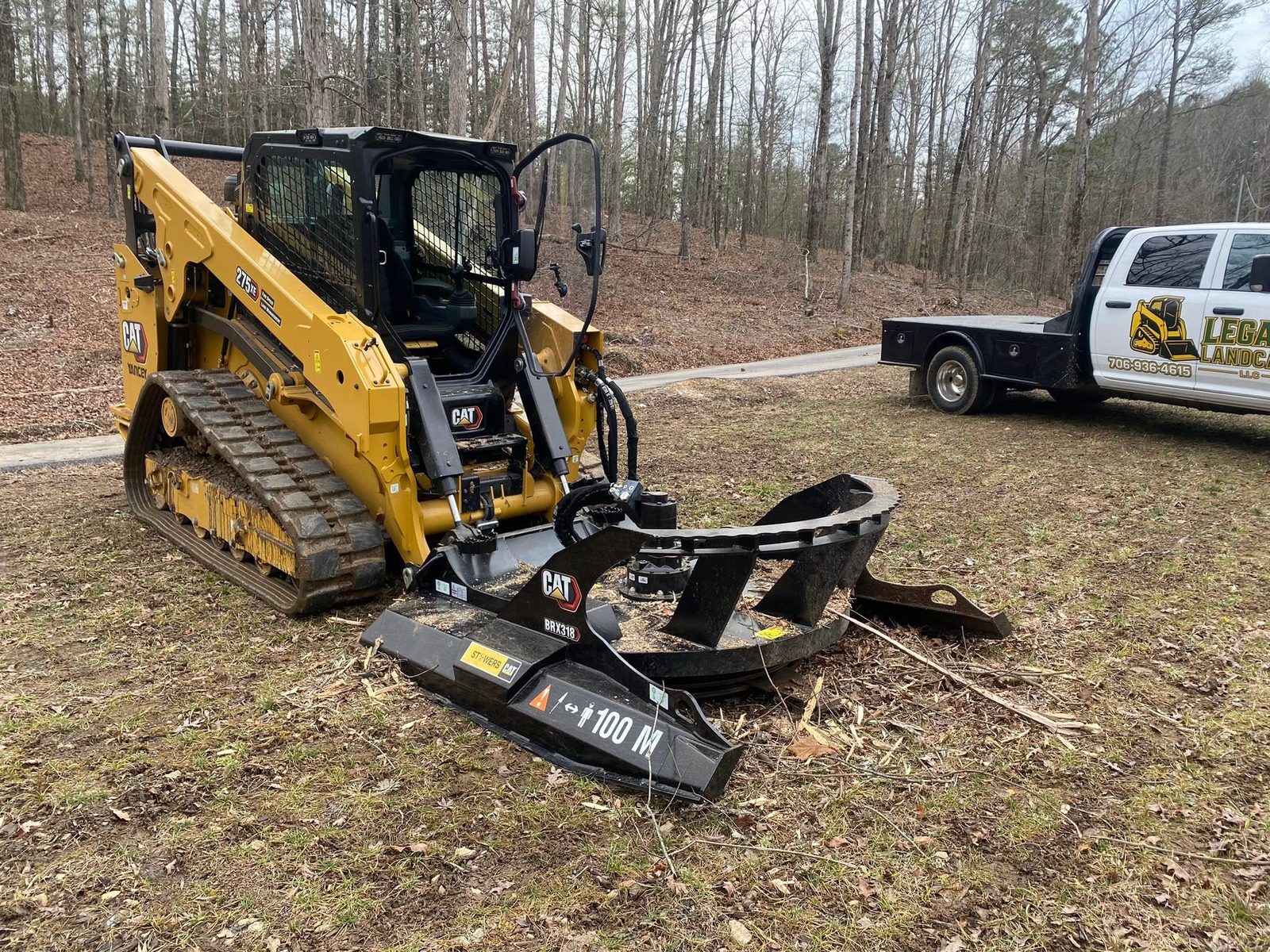
Legacy Land Care handles land clearing and forestry mulching in Fort Payne, AL from our base in Rome, Georgia, about 45 driving miles east. We are a veteran-owned, owner-operated outfit: John Mulkey runs every job himself with a CAT 275XE track loader, a forestry mulcher head, and an excavator, and the company is fully insured. If you own acreage on Lookout Mountain, Sand Mountain, or the valley floor between them, here is how we work in DeKalb County and why the terrain shapes every quote.
Land Clearing in Fort Payne Starts With the Terrain
Fort Payne sits in Big Wills Valley with Lookout Mountain on one side and Sand Mountain on the other, and a big share of the city limits actually runs up onto the Lookout Mountain plateau. That split changes the job. On the mountaintops the soil is thin, often just a few feet of sandy loam sitting on solid sandstone. Push that ground around with a dozer and you scrape off the only topsoil the tract has, then wait on burn weather to deal with the piles. Down in the valley the ground is heavier and wetter, and runoff from two mountain brows all heads toward Big Wills Creek. Land clearing decisions that make sense on the brow are the wrong call on the creek bottom, so we walk every site before the machine comes off the trailer.
Forestry Mulching for Pasture, Timber, and Hunting Tracts
The plateau side of DeKalb County is cattle, poultry, hay, and hardwood, and every pasture up there tries to walk back into privet and sweetgum the moment mowing stops. Forestry mulching is usually the right first tool for that ground. The mulcher grinds brush and small trees where they stand and leaves the material down as a protective layer, so there are no burn piles, no windrows to haul, and the thin plateau topsoil stays put with the root mat holding it. On hunting land out toward Little River Canyon National Preserve, we cut access lanes, open food plot sites, and clear shooting lanes without turning the woods into a mud lot. On working farms, we take grown-up fields and fence lines back to grazable ground.
Typical Fort Payne area work we quote:
- Mulching overgrown pasture, fence lines, and hunting tracts
- Clearing homesite footprints for houses, shops, barns, and RV pads
- Gravel driveways with proper crown, base, and culverts
- Rough and finish grading, dirt work, and building pads
- French drains, swales, and water control on wet ground
Dirt Work Where the Growth Is: I-59, US-11, and New Homesites
Fort Payne's momentum is easy to trace: the Interstate 59 exits, the five-lane stretch of US-11 on the north end, new retail filling in along Gault Avenue, and the Siemens Energy plant expansion adding manufacturing jobs. Commercial buildout like that ripples outward as new houses, shops, and rental pads on land that was pasture a year ago. We handle the ground-level end: lot clearing, grading and site prep, and building pads compacted in lifts so your slab or shop does not settle. For rural homesites around Fisher Crossroads and the other crossroads communities outside town, the first job is usually a driveway and access cut with the right culvert, because the first two hundred feet of gravel decides whether you fight mud every winter.
Water Comes Off These Mountains Fast
Drainage deserves its own mention in this valley. Storm water dropping off Lookout and Sand Mountain has a short trip and a lot of gravity behind it, and flat ground near the creek holds water long after the rain quits. We size culverts for the actual flow, cut swales that move water around pads instead of under them, and install French drains where a yard or barn lot stays soggy. If you are building, the cheapest time to fix drainage is before the pad goes in, not after the slab cracks.
Straight Answers From a Rome, Georgia Crew
We will not pretend to have an office on Gault Avenue. Legacy Land Care works out of Rome, about an hour from Fort Payne, and DeKalb County sits inside our normal working range. What you get is one owner on the machine, an Air Force veteran raised on a Cave Spring, Georgia cattle farm, who quotes the job, does the job, and answers the phone afterward. If you are pricing work, start with our breakdown of what land clearing costs per acre. It was written for Georgia, but the cost drivers it explains, density, slope, and access, read the same on either side of the state line.
Ready to put eyes on your property? Call or text (706) 936-4615 or send the details through our quote form and we will set up a walk-through on your schedule.