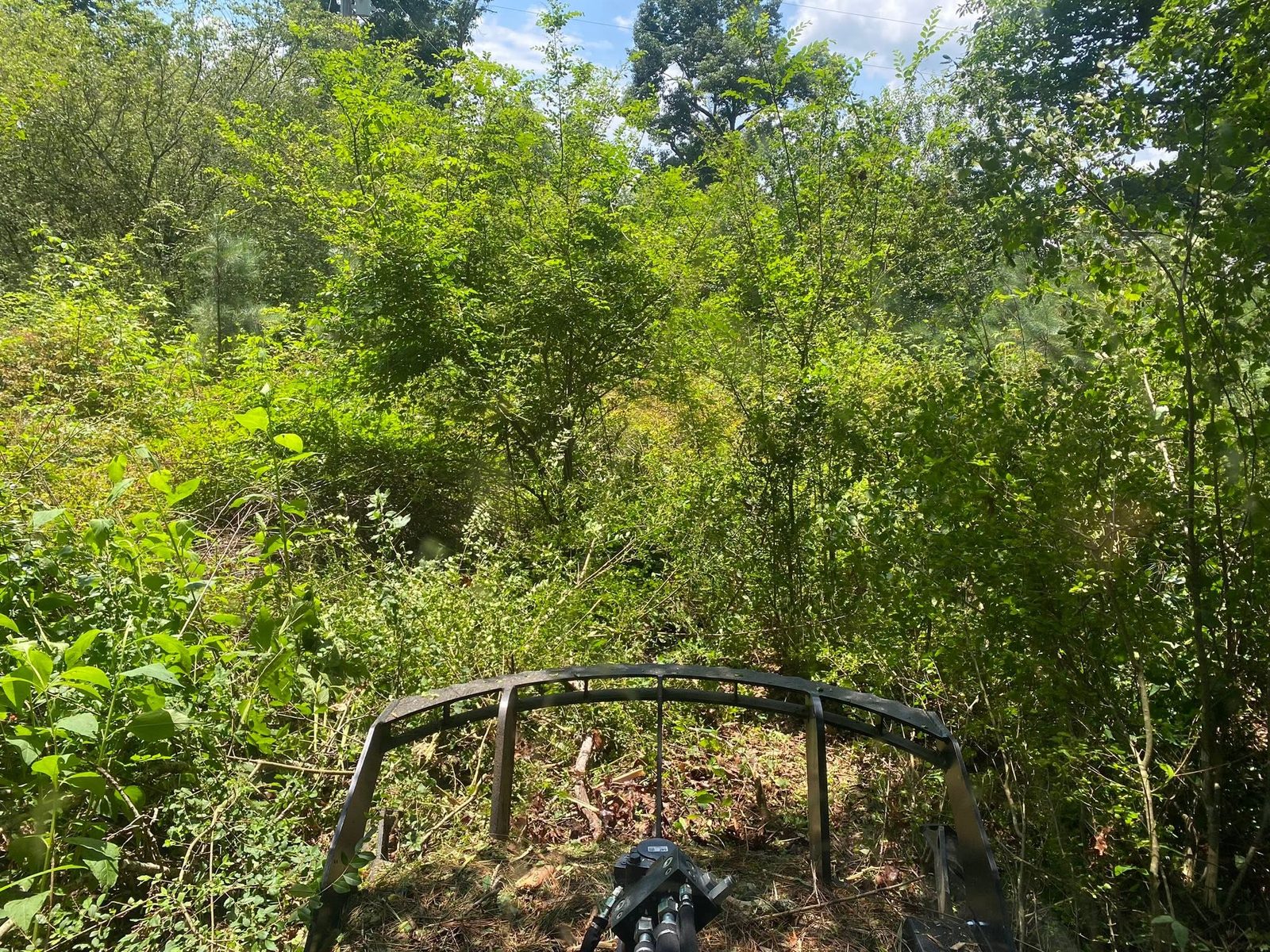
Both forestry mulching and bulldozing will clear a piece of overgrown land, but what each one leaves behind could not be more different, and that difference is the whole decision. One grinds the brush, saplings, and small trees into a cover that stays on the ground. The other shoves everything out by the roots and hands you bare dirt. The real question is not which machine is stronger, but what you need the land to become when the work is done.
What forestry mulching and bulldozing actually do
Forestry mulching uses a track loader carrying a mulcher head to grind standing vegetation into chips right where it grew. Nothing gets pushed into a pile, nothing leaves on a truck, and the dirt underneath is never turned over. We run a CAT 275XE and a forestry mulcher head for this exact work, and the chips fall as a layer of cover across the cleared ground.
Bulldozing works the opposite way. A dozer blade shears vegetation off at the base and shoves it, stumps and all, into windrows and piles you then have to burn or haul off. It scrapes away a layer of topsoil in the process, but it also hands you a clean, diggable surface. When a job genuinely needs that bare-ground result, we produce it with the excavator instead of a blade, grubbing the stumps and roots out and shaping the dirt from there.
Cost: why mulching usually comes in lower
On most overgrown tracts, mulching costs less per acre, and the reason is simple. It is one machine making one pass with no cleanup bill behind it. No piles to burn, nothing to haul to a dump, and no stumps handled one at a time. Bulldozing carries every one of those steps, and each is more time and more iron on your invoice. Mulched ground is done when the machine drives off, while a dozed site still needs the debris cleared and graded before it is usable. We keep dollar figures off a blog page, because terrain, density, and access move them too much. For real ranges to budget against, our guide to land clearing cost per acre in Georgia lays them out.
Erosion and topsoil on Georgia clay
This is where the two methods separate the most. Mulching leaves the ground covered and the topsoil intact. That chip layer slows runoff moving over the surface, shades out some regrowth, and keeps the soil where it is, which counts for a lot on red clay and any slope. Bulldozing does the opposite. Once the blade strips the cover and the topsoil with it, bare clay sits exposed to the next storm, and bare clay on a grade washes fast. If your ground slopes, sits near a creek, or already sheds water hard, that stripped surface can turn into a fresh erosion problem. Our guide to stopping erosion on a Georgia slope covers why that happens and how to get ahead of it.
Stumps, roots, and whether you are building
Mulching does not take out stumps. The head can shave a stump flush with the dirt, but the root ball stays put in the ground below it. For pasture, trails, hunting ground, or a fence line, that is fine, and the roots even help anchor the soil. It stops being fine the moment you plan to build on the spot. A slab, a footing, a driveway, or a pond cannot sit over roots that will rot and settle, so those have to come out. Pulling stumps and grubbing root balls is excavator work, and it is the line where a mulching job turns into full land clearing.
Timeline, terrain, and access
Mulching runs as one continuous operation, so the work moves at a steady pace and the site is finished on the last pass. Bulldozing is really several jobs stacked together: push, pile, burn or haul, grub, then grade. Each stage adds time, so full clearing to bare ground takes longer than mulching the same acreage. Terrain tips the scale too. Our CAT 275XE rides on rubber tracks and puts down low ground pressure, so it handles wet spots, wooded ground, and moderate slopes without bogging or rutting, and it works tight against fences and tree lines where a dozer blade cannot fit cleanly. Heavy dozer work wants room and firmer, more open ground. For how long a clearing job actually takes by acreage, see our timeline breakdown.
The finished result you are left with
After mulching, the tract blends back into the woods around it: a covered, walkable surface, the mature trees we flagged to save still standing, and a chip layer working its way into the soil. After bulldozing, you have a blank slate, bare and open and ready to dig, stake, and build. A hunter reclaiming a bedding area wants the first. A builder setting a foundation wants the second. The look you are after is often the fastest way to know which method fits.
Which one your land actually needs
Lean toward mulching when you are reclaiming overgrown pasture, opening a fence line or trail, or improving hunting ground, when you want views and access without disturbing the grade, or any time erosion or a slope is in play.
Lean toward full clearing when a structure is going on that footprint, when stumps and roots have to come out for a foundation or pond, or when the land needs reshaping, not just the brush knocked back.
Most real jobs are not one or the other. A typical Northwest Georgia homesite gets mulched across the whole tract for access, then only the pad, driveway, and septic area get grubbed and graded. You pay the lower mulching rate across the acreage and the full-clearing rate only where the building lands. On our end, that means running the mulcher head across the property first, then bringing the excavator in for the footprint and shaping the pad under grading and site prep. It is why we treat forestry mulching as one tool in the kit, not the answer to every acre.
Not a do-it-yourself decision
Neither method is a weekend project. Both need a machine and an operator who can read what the land is trying to become, so choosing between forestry mulching vs a dozer is worth a phone call before anyone starts. An honest operator will tell you when mulching covers the whole job and saves you paying for full clearing you do not need, and say just as plainly when the footprint has to be grubbed to bare ground. If you are still weighing mulching or clearing, or even whether a lighter pass would do, our comparison of bush hogging vs forestry mulching covers the maintenance end of the same question.
Not sure whether your land needs mulching, full clearing, or some of both? That is what our free on-site walk is for. Call (706) 936-4615 or request a free quote, and we will look at what is growing, hear what you want from the ground, and tell you straight which method gets you there. We are veteran-owned, owner-operated, and fully insured, and the estimate never costs you a thing.