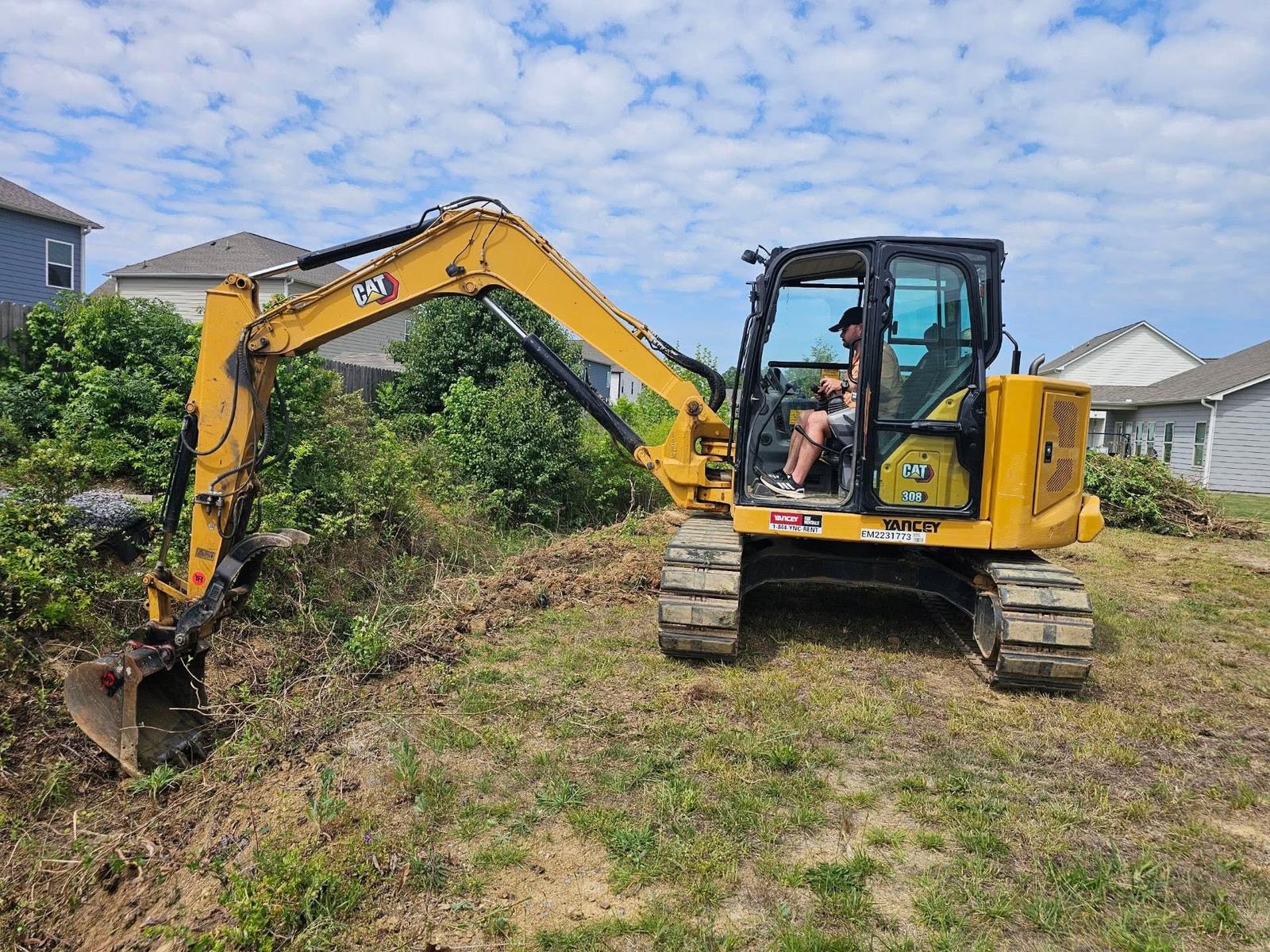
Fairfield Plantation is not a town. It is a Census designated place in Carroll County, about four square miles of land wrapped around two lakes, with 2,025 houses and 4,898 residents counted in 2020. Nearly a tenth of its total area is water. That combination, small lots on steep ground with a shoreline at the bottom of them, produces a set of problems that none of the incorporated towns nearby have to deal with, and it is what makes the work here its own category.
Two Lakes and Not One Highway
Treasure Lake and Fishing Lake are the named water. The Census road file lists roughly 204 named local streets inside the boundary and not a single state or federal route anywhere in it. Everything reaching this place arrives on a county road first: Fairfield Road, Moss Ferry Road, Little Vine Church Road, Sandhill Hulett Road, Chipley Creek Road.
That layout is the first constraint on any job. Streets are narrow, they curve, and they were laid out for cars rather than for equipment on a trailer. Lots are close together with established trees, irrigation, and finished landscaping already in place. Getting the right size machine to the back of a property without tearing up the front of it is genuinely the planning question here, and it gets answered by walking the route from the street before anything is quoted, not by looking at square footage.
The Ground Falls Toward the Water
The single largest soil map unit inside the boundary is a Madison gravelly fine sandy loam on 15 to 25 percent slopes. Roughly a third of the ground sampled here sits in a slope class of 15 percent or steeper, and the place spans close to 280 feet of elevation, from about 948 feet at the water to about 1,227 on the high side. Another share is a severely eroded Madison clay loam phase, meaning the sandy topsoil is already gone off that ground and clay is what a shovel meets first.
Steep ground with a lake at the bottom concentrates every drainage decision. Roof water, driveway water and street water all arrive somewhere, and on a sloped lot they arrive fast and together. The wrong answer is to chase water at the low end of the property, because by the time it gets there it has already gathered speed and volume. Drainage and water control on these lots means catching it above the trouble: a swale that intercepts sheet flow before it reaches the house, a line with real fall where a slope pushes against a foundation wall, and a discharge point that releases without simply handing the problem to the lot below. On ground this tight, where the water goes at the end of the pipe matters as much as the pipe.
Stone in the Loamy Sand
The other soil worth knowing here is Louisburg, which covers close to 15 percent of the ground and shows up in stony phases on 6 to 15 and 15 to 25 percent slopes. Stony is not a figure of speech in a soil description. It means stones are a mapped characteristic of the material, and they turn up in trenching, in footing work, and in any cut deep enough to matter.
Practically, that means a drainage line across a Louisburg slope does not always go in at the pace a Madison slope would allow, and a job priced on the assumption of clean digging can run long. It is far better to know that from the mapping and plan a route around the worst of it than to find out with a machine sitting on a customer's lawn. Where a pad, a slab or a level area is going in on that ground, grading and site prep has to account for what the finished elevation is actually going to be able to reach.
This Corner Drains East
Almost everything in the western half of Carroll County sends its water west toward the Tallapoosa. Fairfield Plantation does not. It sits in the Upper Dog River subwatershed, which is Chattahoochee water heading east and eventually south. Ayer Creek carries better than three miles of channel inside the boundary, with Crawfish Creek and Gum Branch behind it, and Bay Springs Creek reaches its mouth in here as well.
For a homeowner that has one concrete consequence. The low ground on a lot here is usually tied into a lake or into one of those creeks, which means there is a real outlet available within reach on most properties. That is a genuine advantage over a lot of the county, where water has to be routed a long way to get anywhere. It also means the discharge end of a drainage plan deserves attention, because water leaving one lot at speed reaches a shoreline or a channel quickly.
Working Inside a Built Neighborhood
Most of what a property here needs is finish work at machine scale. Yard leveling deals with what a sloped lot does over time: a terrace that has slumped at one end, mulch and soil migrating downhill every season until the upper beds are shallow and the lower ones are buried, a mower strip too steep to keep, a soft shoulder where the lawn meets the drive. Reworking that with a machine that can hold a grade is what makes the difference between a yard that stays put and one that keeps being rebuilt by hand every spring.
Drives run short and steep here, and they fail at the edges and at the base rather than in long washes. Driveway and access work means shaping the surface so water leaves it before it can run the length, dealing with the shoulder that is undermining, and rebuilding the base where it has gone soft under the load. Where a wooded lot has never been built on, land clearing opens the footprint and takes the stumps out, and on a lot with neighbors on both sides the plan for what stays matters as much as the plan for what goes. Excavation and dirt work handles footings, hauling in fill, taking spoil out, and the awkward access that comes with a built street.
Sloped lot, a wet corner that keeps coming back, or a drive that is losing its edge? Call or text John at (706) 936-4615, or send the details through the quote form. The route in gets walked before anything gets priced.