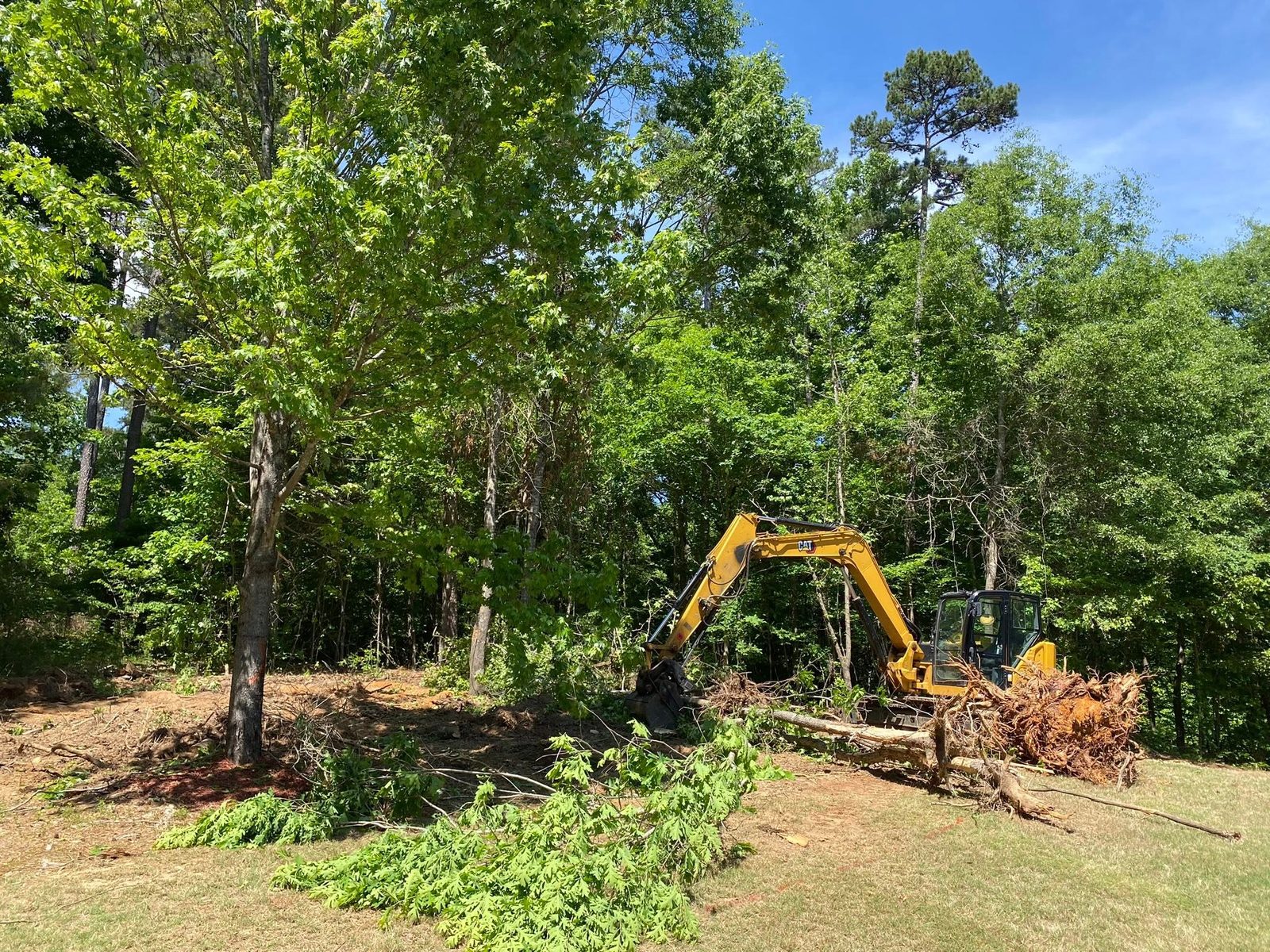
Kingston is a small town by design and by history: about 722 people live inside its 1.26 square miles, and it earned its place on the map as a railroad junction rather than a farm crossroads. Legacy Land Care serves Kingston, GA with land clearing, forestry mulching, grading, and gravel driveway work from our shop in Rome, 13 miles west on GA 293, the same road that runs straight through the middle of town. We are veteran-owned, fully insured, and owner-operated, so the person quoting your property is the same one running the machine on it.
A Junction Town That Never Grew Past Its Rail Yard
Kingston exists because two railroads met here. The Western and Atlantic line reached this stretch of Bartow County in the 1840s, and when the Memphis Branch Railroad connected Rome to that main line in 1849, Kingston became the point where the two crossed. That junction made the depot busy enough that Andrews' Raiders got stuck in it: on April 12, 1862, the stolen locomotive General was forced onto a siding here while other trains cleared the main track, a delay that nearly let the pursuing crew catch up before the chase ever reached Ringgold. Two years later, William T. Sherman set up headquarters at the Hargis House for four days in May 1864 while sorting out where Joseph Johnston's army had actually gone. None of that history changes what the ground needs today, but it explains why a town this size still shows up on Civil War maps more often than on modern ones.
Rock Close to the Surface
South of town sits Kingston Saltpeter Cave, the largest cave in Bartow County, dug into limestone the Confederacy mined for gunpowder during the war. That cave is not just a curiosity, it is a hint about what sits under a lot of ground around Kingston: limestone bedrock that sits closer to daylight than most people assume once the ground rises off the flat bottomland. We check for it before committing to a cut. A pad or a drainage line planned around shallow rock costs a fraction of one discovered by hitting it with a bucket. Our excavation and dirt work accounts for that from the first site visit, and where digging is not the right approach, our forestry mulching clears overgrown fence lines and pasture edges without disturbing what is underneath.
Farmland Outside a Town You Can Walk Across
Kingston's town limits are small enough to cross on foot in a few minutes, but the land around it stretches out fast into the kind of west Bartow County farmland this whole corridor is known for: hay fields, cattle pasture, and wooded creek bottoms running down toward the Etowah River south of town. That is where most of our land clearing calls come from, not the historic district. Fence rows that have gone to privet and cedar, pasture edges that have crept in a few feet a year until a field is half its deeded size, and homesite footprints on family land that has sat wooded for a generation. We run a CAT 275XE fitted with a mulching head for exactly this kind of reclamation, chipping brush and saplings where they stand instead of pushing them into a pile that has to be burned or hauled off.
Gravel Driveways on Long Farm Roads
Once you are past GA 293 and onto the county roads branching off it, driveways get long, and Bartow County clay does not forgive a driveway that was never shaped right in the first place. Our gravel driveway and access road work starts with a compacted base and a real crown, plus culvert pipe wherever a ditch line crosses, so rain runs off to the sides instead of pooling down the centerline and turning the whole drive to soup by February. On a long rural approach that is the difference between a driveway that needs stone dumped on it every year and one that mostly takes care of itself.
A Town That Still Marks Its Own History
A state historical marker on East Railroad Street credits Kingston with the nation's oldest continuous Memorial Day observance, tracing back to a Decoration Day held in the town cemetery in late April of 1865. Whatever the exact ranking, the town has clearly kept up the habit of remembering where it came from, and the depot grounds and antebellum storefronts downtown still carry that history in plain sight. We mention it because it is true and because it says something about the kind of place Kingston is: small, particular about its own ground, and not interested in pretending to be bigger than it is. That is also how we approach every property we quote here.
Have ground near Kingston that needs clearing, grading, or a driveway rebuilt? Legacy Land Care is based 13 miles away in Rome, owner-operated, and fully insured. Call or text John at (706) 936-4615, or request a quote online for a straight number on your property.
Excavation and Dirt Work: Pads, Footings, and Hauling on Kingston Ground
Most of what we get called about around Kingston is not the rock, it is the dirt that has to move before anything else can happen. A shop or barn going up on family land west of town follows the same sequence every time: strip the topsoil, cut the high side, fill the low side, and compact it in lifts so the pad holds instead of settling under weight. Footings for a pole barn or an addition follow the same logic on a smaller scale, dug to depth and backfilled right rather than guessed at. Long farm lanes and tight turns around outbuildings make close access the norm here, and our CAT 275XE and excavator are sized for it. When fill has to come in or spoil has to leave, that is excavation and dirt work we handle on the same visit as the rest of the property.
Fence Line and Fence Row Clearing on Kingston Cattle Ground
Cattle and pasture ground around Kingston loses its fence lines to privet, briars, and volunteer saplings faster than most owners expect, and a boundary clear a few seasons ago can disappear into a green wall along the wire. We run the forestry mulcher tight along fence rows and property lines, grinding that growth down in place so the line is visible and walkable again, with the mulch layer left behind to slow what tries to come back. That covers perimeter pasture fence and interior cross-fencing alike, opened up for a new run of wire or a boundary check. We clear the fence line; the wire itself stays with a fencing crew. On hay fields and pasture toward the Etowah bottoms, that is often what keeps ground reading as farmed instead of going back to brush. See our fence line clearing page for the full scope.