Marietta is the Cobb County seat and it covers about 23.8 square miles. The 2020 census blocks inside the current city limits hold roughly 60,500 people in about 26,400 housing units, which comes out near 1,100 homes to the square mile. That is a finished town. There is almost no raw ground left inside it, and a page about clearing timber here would be a page about work that does not exist. What a dirt contractor actually gets called for in Marietta is water arriving where nobody wanted it, a yard that was never finished properly, a drive that has quit, and old concrete somebody is tired of looking at. Legacy Land Care is veteran owned and owner operated. John Mulkey runs the machine himself and drives down from Rome to do it.
Three Watersheds Meet Inside One City Limit
Marietta sits on a drainage divide, and the divide runs through the middle of town. Tested on a grid, about 51 percent of the city drains toward the Upper Chattahoochee, about 37 percent goes the other way toward the Middle Chattahoochee by way of Sweetwater Creek, and about 12 percent heads north into the Etowah. Six named subwatersheds take a share of the city, led by Upper Noses Creek, Sope Creek, and Rottenwood Creek. Eight named streams run inside the limits: Rottenwood Creek carries about four and a third miles of channel here, Sope Creek about three and a half, then Ward Creek, Noses Creek, Poorhouse Creek, Olley Creek, Noonday Creek, and a short piece of Powers Creek.
At lot level that means one thing. Two houses a few streets apart in Marietta can sit on opposite sides of a ridge and send their runoff to different rivers. There is no single citywide answer to a wet back yard here. The first thing worth establishing is which way your ground actually falls, and on a graded subdivision lot that is frequently not the way the street runs. That is why drainage and water control begins with a walk and a level rather than with a catalog of parts.
The Older Blocks Were Shaped to a Different Standard
About 21 percent of Marietta housing predates 1970 and about 36 percent predates 1980, against a citywide median build year in the middle 1980s. So the city is really two building eras stacked on the same map: an old core around the square and the courthouse blocks on Haynes Street and East Park Square, and decades of later subdivisions filling in around it.
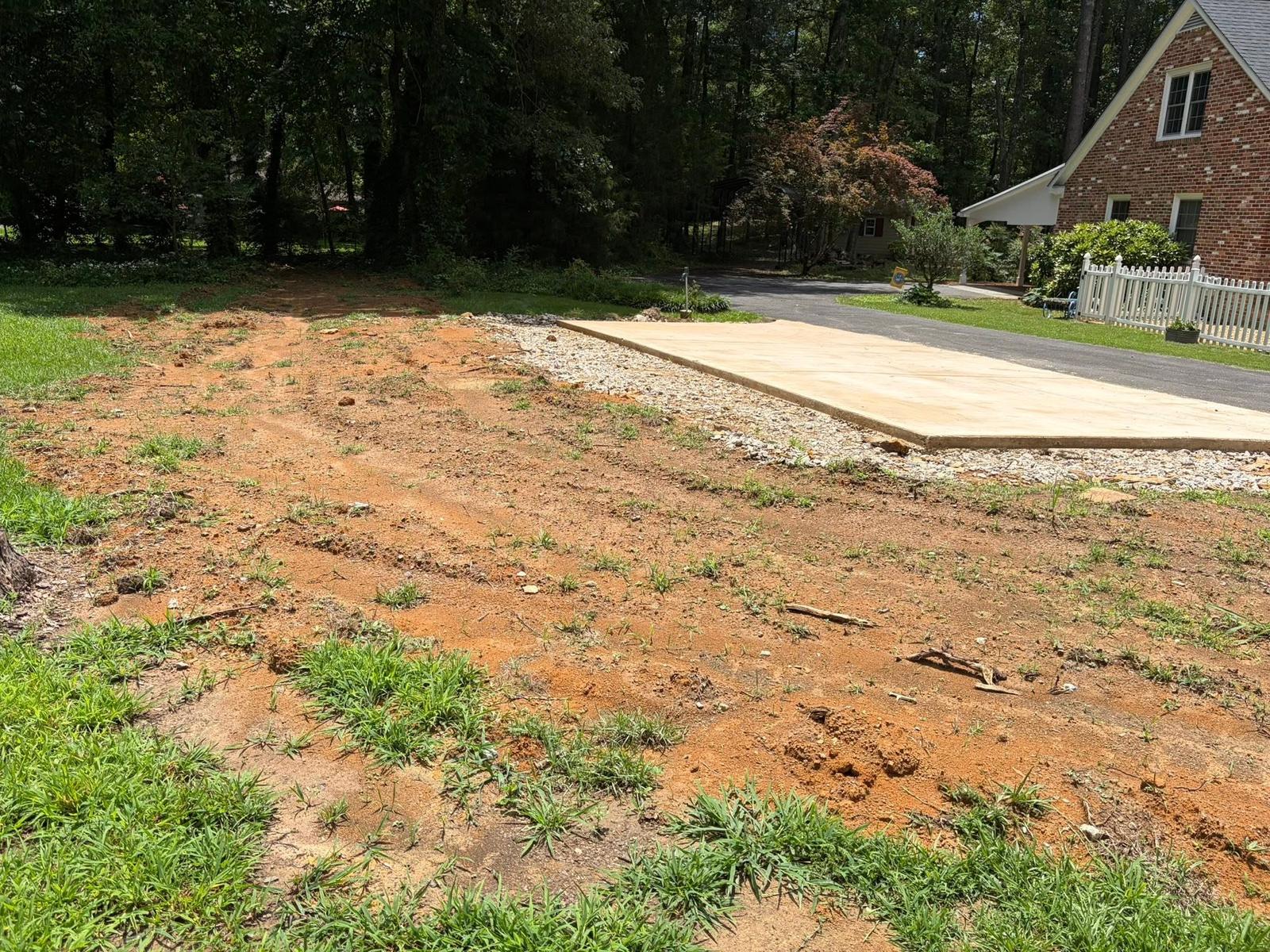
Age changes the diagnosis. On an older lot, the first two things to check are where the downspouts let go and whether the ground within six feet of the wall still falls away from it. Fill settles. Beds get built up against siding. A patio poured twenty years after the house frequently sits a little proud and turns into a low dam. None of that is dramatic and all of it is fixable with a machine and a day. Yard leveling handles what happens above ground, and on the older streets it is usually the part that pays for itself first.
Urban Land, Borrow Pits, and What Is Under the Grass
Clip the soil survey to the Marietta limits and it comes to roughly 15,200 acres. The largest single map unit is Gwinnett clay loam on 6 to 10 percent slopes, severely eroded, about 940 acres of it. The more useful number is how much of the city the survey stopped calling soil at all. About 810 acres are mapped as urban land outright, and several thousand more acres are mapped as urban land paired with Pacolet, Cecil, Madison, Appling, or Gwinnett. Another 640 acres or so carry the map unit name urban land and borrow pits, which is the survey saying plainly that dirt was dug out of this ground and hauled somewhere else before the houses got here.
Marietta also holds real low ground. About 650 acres inside the limits are Cartecay fine sandy loam, which the survey rates frequently flooded, and about 560 acres are Toccoa, rated occasionally flooded. Set against that, about 1,100 acres are Musella and Pacolet stony soils on 10 to 45 percent slopes, shallow ground where weathered rock is close enough to the surface to matter to a bucket, and about 1,200 acres are Hiwassee, a deep red soil that digs clean. Three very different diggings inside one city, which is why the price comes after the walk and not before it.
Driveways and Access on a Built Out Lot
Sampled across the city, Marietta ground runs from about 915 feet up to about 1,240, so there is better than 300 feet of relief spread across town. A drive that runs downhill to a garage is a channel whether it was built to be one or not, and the fix is rarely more asphalt. It is pitch, an interruption partway down so no single stretch collects the whole run, and a place for the water to go that is not the low corner of the garage floor. That is what driveway and access work means on a town lot.
Access is the other constraint. Between I-75, US 41 on Cobb Parkway, the Marietta Parkway loop, Whitlock Avenue, Roswell Road, and South Cobb Drive, getting to a Marietta address is easy. Getting a machine into the back yard is the part that gets decided at the gate. Fence width, the side yard pinch between the house and the property line, a septic field or a patio in the path: those get looked at before anything is scheduled, not after.
Old Slabs, Old Sheds, and What Comes After
A lot of Marietta backyard projects start with subtraction. A rotted shed on a slab. A cracked patio. An old pool deck, a burned out fire pit, a set of steps to nothing. Small structure and slab demolition clears the footprint, and the part people forget is what the ground looks like underneath when the concrete leaves. There is usually a stone base under an old slab and a shallow bowl once it is out, and that hole will hold water all winter if nobody shapes it. Taking the concrete out and putting the grade back are one job, not two. Heavier cuts and fills, spoil handling, and getting a new pad set where the old one was fall under excavation and dirt work.
Standing water, a yard that has never been level, a drive that washes, concrete somebody wants gone: those are the four Marietta calls. Phone or text (706) 936-4615 and you get John. The quote form takes a street address and a couple of pictures if that is easier. Fully insured, one owner, one machine, one number.