Bowdon fits inside three and four tenths square miles, which makes it the smallest footprint of any town this company covers on the Carroll County side. The 2020 blocks counted 2,161 people and 972 houses on it. Everything is close together, the ground under nearly all of it is good, and the constraints on a job here are almost never about the dirt. They are about where a machine can get to and what happens to the water once you change something.
No Lake, No Pond, Half a Mile of Creek
The Census puts Bowdon's water area at zero. Not small, zero. One named stream touches the limits, Indian Creek, and only about half a mile of it. The subwatershed is called Cedar Valley-Indian Creek, and Cedar Valley itself is a place name inside these same limits.
That single fact governs more drainage work here than the soil does. On a property with a creek at the bottom of it, water has an obvious destination and the job is getting it there in good order. In Bowdon there is usually no channel within reach, so every drop that lands on a lot leaves across other lots. Raise a low spot with fill and the water goes to the next lowest thing, and on a town this compact the next lowest thing generally belongs to somebody else. The workable answer is a route rather than a fill. On a lot with space that means a shallow open channel carrying water out to the street ditch. Where there is no space, it means pipe with enough fall to keep moving and a release point that actually discharges instead of dead ending in the lawn. That is what drainage and water control reduces to inside these limits.
Two Soils Cover Six Acres in Seven
Madison runs about 63 percent of the ground inside the city limits and Grover another 22, which puts roughly six acres in seven on one or the other. Both are deep red soils weathered off gneiss and schist, both rated well drained, and both sit in a low runoff class. In plain terms this is some of the friendliest dirt anywhere in the county. It cuts clean, it compacts properly when the moisture is right, and there is enough depth to work with. No depth restriction is recorded on either one.
Two cautions come with that. Madison smears when it is worked wet and stops bonding, so a pad pushed together during a soggy week keeps settling long after the concrete is down. And about one point in ten across the limits is a severely eroded clay loam phase where the sandy topsoil has already gone, which behaves like a different material even though it carries the same series name. Flood plain soil accounts for roughly another one in twelve, tucked in low along the drainage.
Nothing Steep, Which Changes What Goes Wrong
Not one map unit in the sample across Bowdon rises above the 10 to 15 percent slope class, and the whole town sits inside about 155 feet of elevation, roughly 962 feet at the low end to 1,117 at the high. That is the tightest range of any place on this side of the service area.
Gentle ground fails differently than steep ground. Nothing here washes out dramatically. Instead the water spreads, slows, and stops wherever the fall runs out. Yards hold puddles for days. Gravel presses down into soft ground under load instead of migrating downhill. A slab poured on a lot with no fall away from it collects roof water against the foundation for twenty years. All of that is fixable, and all of it gets fixed with grade rather than with volume.
Pads, Drives and the Room to Build Them
Because the soil cooperates, grading and site prep in Bowdon is mostly a matter of doing the ordinary things properly. Strip the organics instead of burying them under the pad. Place fill in lifts thin enough to compact rather than one dumped pile pushed flat. Set the finished elevation high enough that storms leave the pad rather than settle on it. Shops, detached garages, barns and RV spots all take the same approach at different scales.
Drives here are short by rural standards, running off a street rather than a quarter mile off a county road, and what goes wrong with them is a bearing problem rather than a water problem. A gravel surface only works while the stones are locked against each other. Once soft ground lets individual stones move down and sideways under a wheel, the surface loses its interlock and every trip after that makes it worse. That is why depth alone never rescues a bad drive. Gravel driveway and access work here means getting down to material that will carry a load, giving the aggregate something firm to lock against, and confining the edges so the surface is not free to spread. Excavation and dirt work covers the rest of it: footings, hauling in fill, taking spoil out, and squeezing a machine into a spot a bigger outfit would rather not attempt.
Taking Something Down Before Putting Something Up
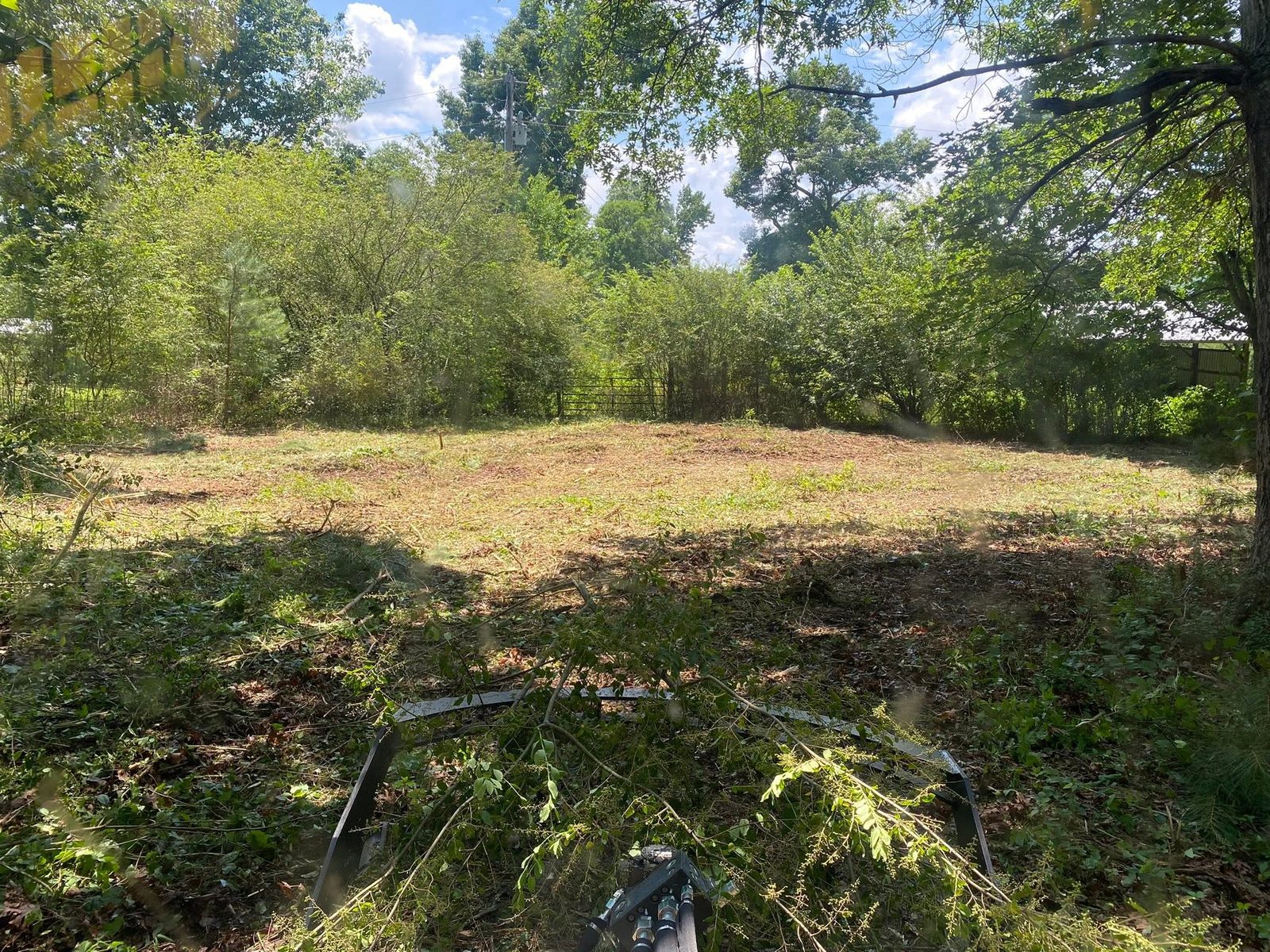
On lots this size the thing standing in the way is often a structure rather than a tree. An old shed, a collapsed barn, a slab from a building that came down years ago, a stretch of failed concrete drive. Demolition handles that: down, loaded, hauled, and the ground behind it graded so the next thing can actually be built. Where the obstacle is growth instead, land clearing takes the stumps and root balls out of a footprint, which on deep unrestricted soil is straightforward work.
State Routes 100 and 166 carry the traffic, College Street runs east and west through town, and North Carroll Street and the Wedowee Street corridor head out from there. Past them it is Bowdon Tyus Road, Lovvorn Mill Road, Brickyard Road, Sandy Flat Road and Garrett Creek Road, where the parcels open back up and the same work happens at acreage scale.
Pad to cut, drive to rebuild, or a wet corner with nowhere obvious to send the water? Call or text John at (706) 936-4615, or send the details through the quote form. He walks the lot before he prices it.