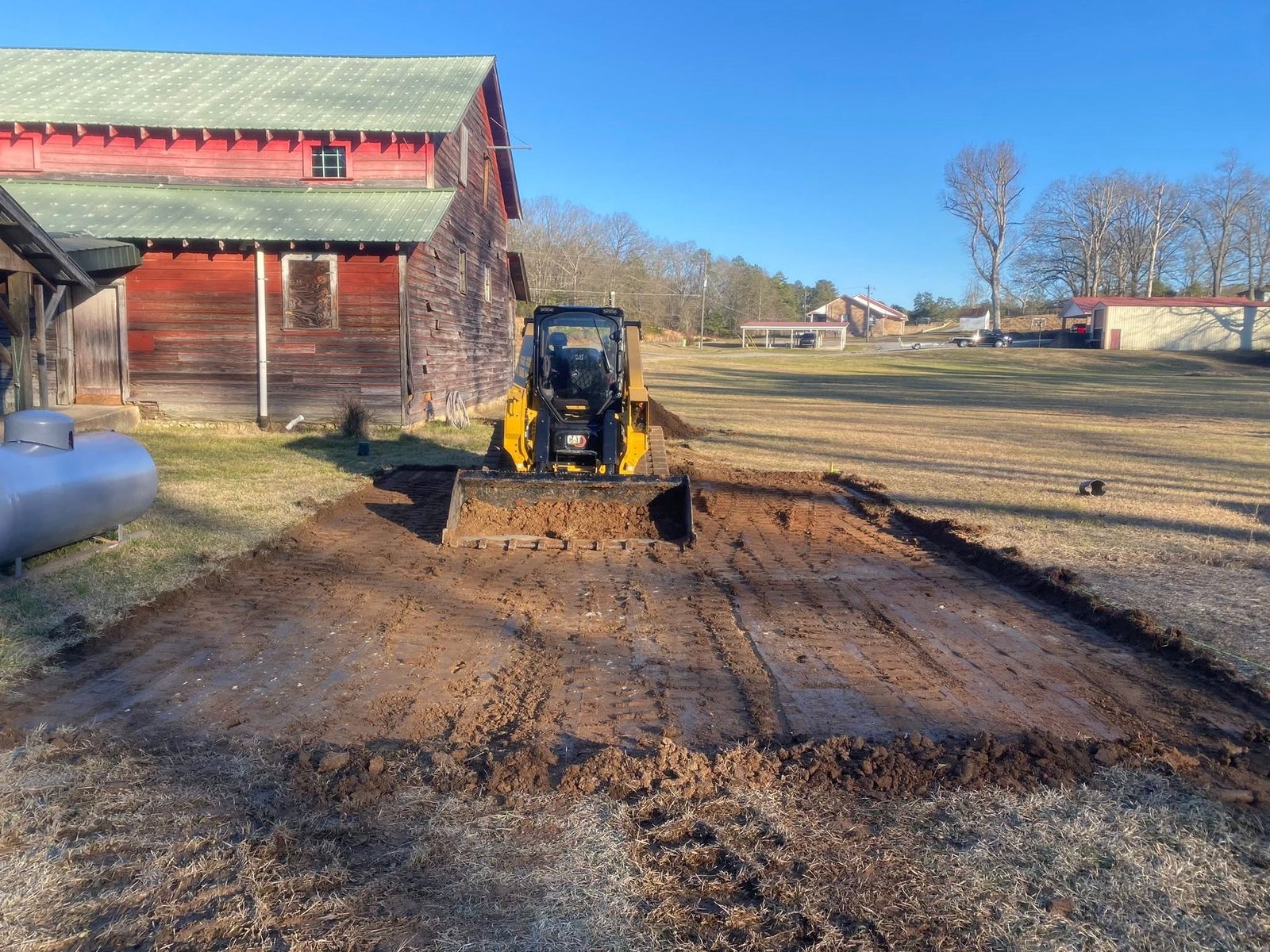
If you've got a spot in the yard that stays wet for days after it rains, water running toward your foundation, or a low corner that turns to mud every time it storms, Georgia red clay is not going to fix that on its own. A French drain moves that water somewhere it won't cause damage, and here's exactly how we install one.
What a French Drain Is and When You Need One
A French drain is a gravel filled trench with a perforated pipe at the bottom that collects water and carries it away from your foundation, a soggy patch of lawn, or a hillside that never dries out. It works because it gives water an easier path than sitting in heavy clay, which holds water instead of letting it soak through.
You probably need one if:
- Water pools in the same spot for hours or days after it rains
- Water is running toward your foundation, crawl space, or basement
- A slope on your property stays soggy and won't grow grass
- Standing water is killing grass or drawing mosquitoes year after year
If your main problem is a slope washing out rather than water sitting still, that's a related but different fix. Check out our guide on stopping erosion on a slope instead.
How to Install a French Drain, Step by Step
Here's the process, start to finish. Skip a step and you'll likely be redoing this in a year or two.
- Find where the water collects and where it can go. Watch your yard during or right after a hard rain and note where water sits and which way it moves. You need a low point to collect it and a lower point downhill to send it, such as a ditch, the street, or a dry well.
- Dig the trench with a consistent slope. Keep a steady grade of about 1 percent, roughly a 1 inch drop every 8 feet, from the collection point to the outlet. A flat stretch or high spot anywhere in that run is enough to stop water from moving.
- Lay a gravel base. A couple inches of washed gravel at the bottom gives the pipe a stable, well draining surface instead of sitting directly on clay.
- Set the perforated pipe with the holes facing down. Water needs to seep up into the pipe from the gravel below. Holes facing up just fill the pipe from the top and slow everything down.
- Wrap the pipe and gravel in filter fabric. This is the step people skip, and it's the one that matters most in our clay. Fabric lets water pass through while keeping fine clay particles from working their way into the gravel and clogging the pipe.
- Backfill with more gravel, then soil. Cover the wrapped pipe with gravel, then cap the trench with soil, sod, or mulch so it blends back into the yard.
- Discharge to daylight or a dry well. The pipe has to empty out somewhere, a lower point on the property, or a dry well that lets it soak away from the house. A drain that doesn't discharge anywhere isn't draining anything, it's just a buried pipe full of water.
Common Mistakes That Make a French Drain Fail
We get called out to fix more failed drains than we install brand new, and it's almost always one of these four problems.
- No slope, or not enough of it. Without a steady grade toward the outlet, water sits in the pipe, sediment settles, and the drain slows down and eventually stops working.
- No filter fabric. Bare gravel and pipe in Georgia red clay will clog. It's not a matter of if, just when.
- Pipe holes facing the wrong way. Holes up instead of down means the pipe fills before it drains, so you get standing water instead of steady flow.
- Discharging to nowhere. A pipe that empties into another low spot, or just stops at the property line, only moves the water a few feet. It doesn't solve the problem.
DIY or Call a Pro?
A short, shallow drain for one wet spot is a doable weekend project if you've got the tools and patience to dig through clay by hand. It gets harder with longer runs, anything near a foundation, or a yard where the outlet isn't obvious. Clay is heavy, it doesn't give, and hand digging a trench past 20 or 30 feet wears most people out fast.
Consider hiring it out if:
- The wet area is large or the trench run is long
- You're draining water away from a foundation or crawl space
- You don't have access to a trencher or mini excavator
- You've already tried a drain once and it failed
Cost depends on length, depth, and access more than most people expect. We break down real numbers in what a French drain costs, so you know what you're working with before you start digging or calling around.
Get a free estimate. We install and repair French drains across North Georgia, Southeast Tennessee, and Northwest Alabama. Reach out through our drainage and water control service or call us directly at (706) 936-4615. We're veteran owned and fully insured, and we'd rather build it right than come back to fix it later.