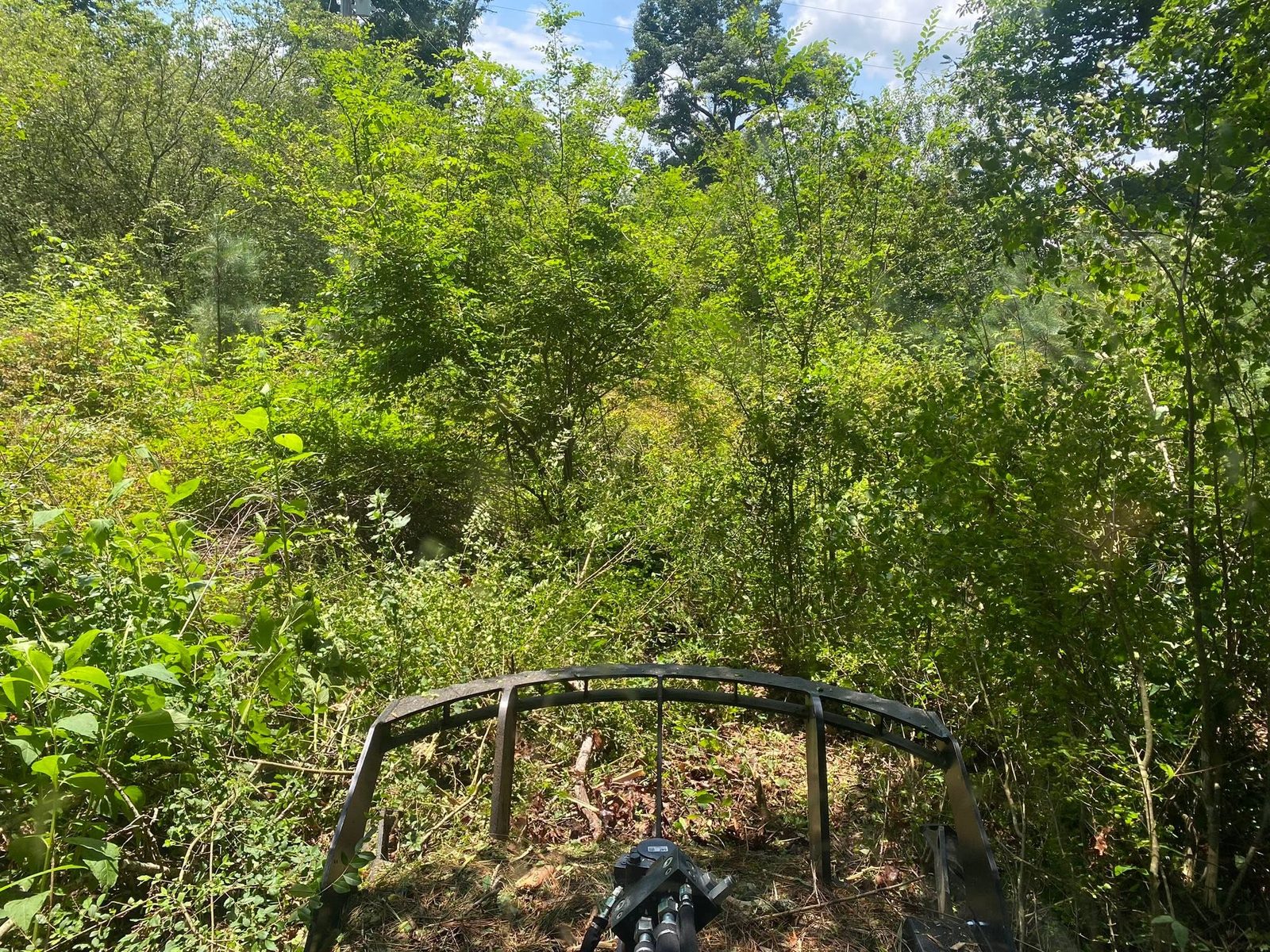
If your land has grown up in brush, privet, and saplings until you cannot walk a straight line across it, forestry mulching is the phrase you keep running into. The whole idea fits in one sentence: a single machine grinds standing growth down where it stands and leaves it behind as a layer of mulch. No piles, no burning, no trucks hauling brush to a dump. This guide covers what forestry mulching is, how it works, what it is good for, where it stops, and when to call for something heavier.
What Forestry Mulching Is
Forestry mulching clears land by grinding vegetation in place instead of cutting it down and dragging it off. The equipment is a compact track loader carrying a mulching head, a rotating drum lined with fixed teeth that spins fast enough to reduce standing brush, vines, and small trees to wood chips. Because the material never leaves the site, there is nothing to stack, nothing to burn, and no dump fees. That one trait, growth turned into ground cover where it fell, is what sets mulching apart from older ways of clearing a lot.
How Does Forestry Mulching Work?
The work is more straightforward than the machine makes it look, and it runs the same order on nearly every job:
- We walk it with you first. Before a tooth turns, we flag the mature trees and buffers you want kept and settle where the clearing ends. The owner runs the machine himself, so nothing agreed to in the yard gets lost on the way to the woods.
- The head clears in a single pass. The loader pushes into the growth and the mulching head chews saplings, privet, briars, and vines as it moves. There is no second crew following behind to cut, gather, and haul.
- The chips drop and stay. What comes off the head lands as mulch over the area you just opened, rather than getting windrowed into a pile at the edge of the property.
- Oversized trunks get set aside. Anything thicker than the head handles cleanly gets flagged and dropped later with the excavator, not forced through the drum over and over.
By the time the machine loads out, you have open, walkable ground under mulch, not raw dirt and not a burn pile.
Forestry Mulching Benefits: What the Machine Is Good For
Mulching is not the answer to every clearing job, but where it fits, it is hard to beat:
- Overgrown lots and pasture edges. Ground that has grown back to brush over a few seasons gets opened up without stripping the topsoil.
- Fence lines and property boundaries. A row swallowed by privet and briars comes back to a clean, visible line. On wire that has to survive the work, that is its own job: fence line clearing.
- Trails and access to the back of a tract. The head shapes a corridor as it clears, so you get a path you can actually drive to a stand or a food plot, covered under recreational land clearing.
- Selective clearing. Because the operator works tree by tree, the understory can come out while the mature hardwoods you want stay standing. The result still looks like your land, not a scraped lot.
- Erosion protection. The mulch left behind shields red clay from rain, slows runoff on a slope, and shades the stumps so regrowth comes in thinner. Bare dirt does none of that.
The Limits: Stem Size and Terrain
We would sooner be honest about where mulching stops than sell you a method that does not fit. Two limits matter most. The first is stem size. A mulching head is built for brush, saplings, and small to medium trees, and past a certain diameter, grinding a trunk stops making sense. Big mature hardwoods are faster to fell and remove with the excavator, and we flag which of your trees fall on which side before we start. The second is terrain. The track loader runs low ground pressure and handles wooded, sloped ground, but steep faces, standing water, and rock still slow it or rule mulching out. Neither one catches you off guard when the property gets walked first.
Mulching vs. Burning and Hauling
The old ways of clearing a lot each create a second job. Push the brush into piles with a blade and you still have to burn them: a dry window, a burn permit in many cases, and a bare scar where the pile sat. Cut it all with saws and you drag it out and haul it off, paying by the load at the dump. Mulching skips that second half. The material is reduced and spread as ground cover the moment the head passes, so there is no pile, no fire, and no haul-off. That is also why it tends to land easier on the wallet: you pay for one operation instead of two. For the fuller head-to-head, including where a dozer still wins, read forestry mulching versus bulldozing.
When Forestry Mulching Is the Right Call, and When You Need More
This is the part worth getting right, because the wrong method costs you twice. Mulching is the right call when the goal is to reclaim standing growth and keep the ground much as it is: overgrown acreage, a lost fence row, trails, or a wooded lot you want thinned, not flattened. It leaves the soil in place and the grade untouched.
It is the wrong tool by itself when the plan is to change the ground, not just clear it. For a house pad, a shop, or a driveway, the stumps have to be dug out and the site cut and filled to grade, which is full land clearing and grading and site prep, not mulching. Very light, grassy upkeep points the other way, toward a bush hog instead of a mulcher, which we sort out in bush hogging versus forestry mulching. Most real projects mulch the acreage and bring in heavier work only where a structure goes; how long each piece takes is covered in how long land clearing takes.
What Forestry Mulching Costs
Price comes down to how thick the growth is, how big the stems run, the terrain, and how many acres you are covering, so no honest number exists without a look at the land. Rather than repeat figures here, we keep the ranges and what moves them in one place: our guide to land clearing cost per acre in Georgia. Match your property to what you read there for a budget bracket, then let us walk it for a real number.
Think forestry mulching might be the fix for your overgrown ground? We are a veteran-owned, owner-operated outfit, fully insured and based in Rome, and forestry mulching is core to what we do across Floyd, Bartow, Gordon, Polk, and the surrounding counties. Call (706) 936-4615 or request a free quote, and we will walk your property, tell you straight whether mulching covers it or you need something heavier, and hand you a real plan and price.