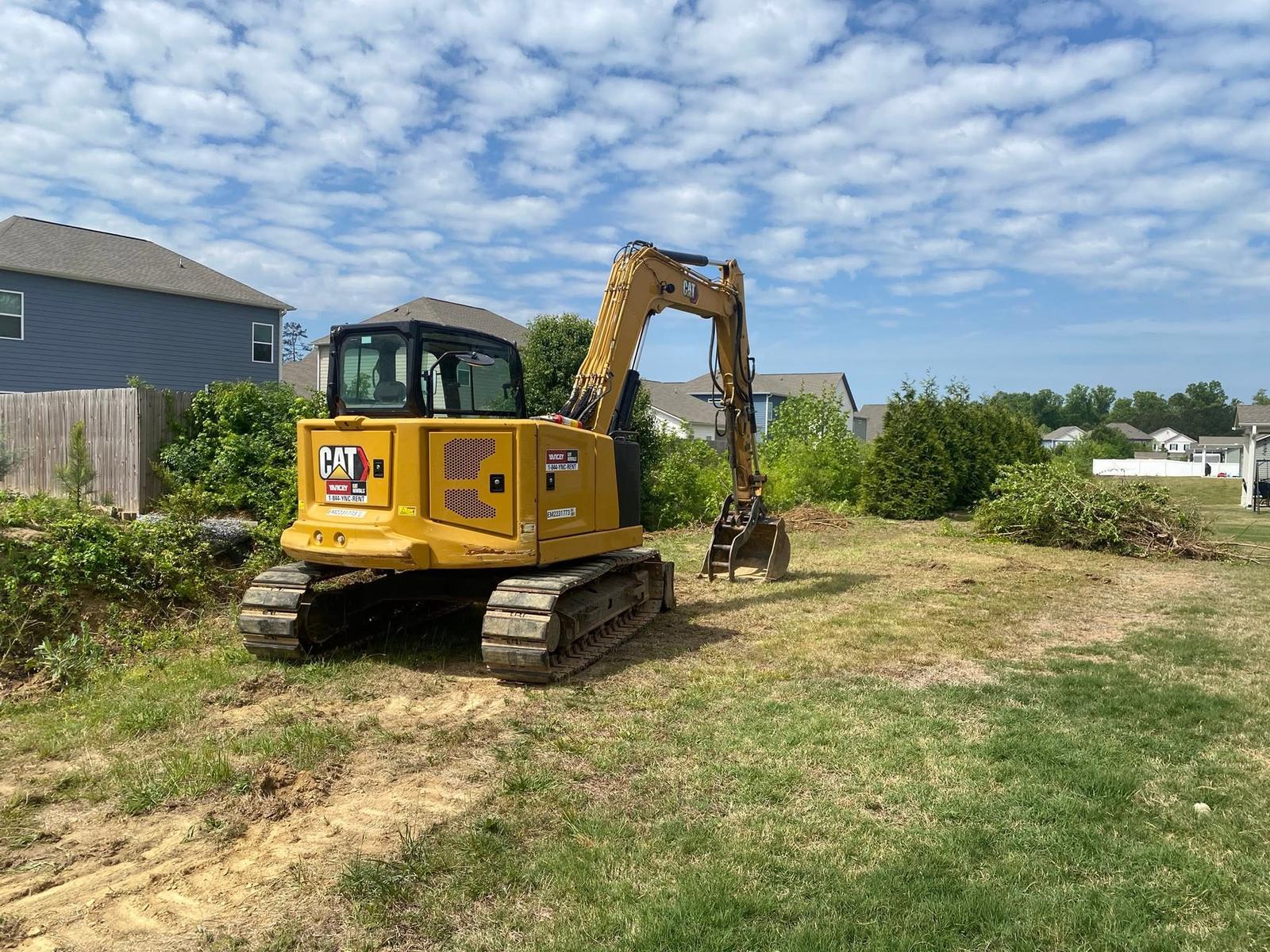
This page is about the north end of Fulton County, Roswell and Milton, and it is worth saying up front that this is the far corner of where the equipment travels. Rome is 48.7 miles from Roswell and 50.1 miles from Milton in a straight line, farther than any of the other counties written up alongside this one. Ask about that before you plan around it. What is on offer up here is not mountain clearing. It is water, grade, and clay on lots big enough that the yard is a real piece of ground.
There Is No Countryside Left in Fulton County
Every other county page on this site opens with the acreage outside the city limits, because that is where most of the work is. Fulton breaks the pattern completely. Test it on a grid and 99.6 percent of the county land falls inside an incorporated city. Four tenths of one percent does not. Fifteen cities cover it, and the two on this page, Roswell at 40.74 square miles and Milton at 38.59, take up better than fifteen percent of the whole county between them.
The old crossroads names are all still on the map and none of them is unincorporated anymore. Crabapple, Birmingham, and Hopewell all sit inside Milton now. Arnold Mill sits inside Roswell. Check any of them against the Census place layer at their own coordinates and a city name comes back. So this record carries no community list, because there is nothing honest to put in it.
What survived is the shape of the land rather than the address. Milton kept its lots large. North of Crabapple you get pasture, board fence, and hardwood between the houses instead of subdivision spacing, and a two acre or five acre yard behaves like a small farm when it rains. That is the actual difference between this work and a quarter acre lot closer in: there is enough ground for water to gather speed, enough for a low spot to hold, and enough that a machine can get in and fix it.
Deep Red Clay Over Granite and Gneiss
Fulton has its own single-county soil survey, GA121, and what it shows is the opposite of the shallow ground up north. Rion leads the county at roughly 141,000 acres, weathered out of granite and gneiss, mapped on slopes from 6 to 35 percent. Cecil is next at roughly 86,000, the red Piedmont clay everybody around here already knows by sight. Neither one carries a recorded depth restriction at all. Between the two they cover about 227,000 acres of the county and a bucket can work them without hitting anything.
The shallowest restriction on any major component in this survey area is Wilkes at 46 centimeters, and after that the numbers get deeper fast: Bethlehem at 76 centimeters, Mountain Park at 81, Gwinnett at 104, Louisburg at 180. Compare that to a county where the dominant soil quits at 38 centimeters and you understand why the work up here looks different. Rock is not usually the obstacle. Clay behavior is.
That clay is the whole story on a lot. Cecil and Rion are both well drained and hydrologic group B, which sounds friendly until it is stripped, wet, and driven on. Bare Piedmont clay seals under traffic, sheds water instead of taking it, and turns greasy on any grade. Down in the bottoms Cartecay covers roughly 24,000 acres, classed somewhat poorly drained where there is no grade to work with, and Toccoa adds roughly 19,000 more. If part of a lot backs onto a creek, that is the soil under the wet corner, and no amount of topsoil will change what it does.
Two soil series in this county were named here. NRCS established Grover in Fulton County in 1951 and Mountain Park in Fulton County in 2006. Mountain Park shares its name with a city inside this same county, which is a small thing but a real one.
North Fulton Sits on a Divide
Most people assume everything around here drains to the Chattahoochee. Most of it does. Roswell and Crabapple both fall in basin 03130001, Upper Chattahoochee, and Foe Killer Creek and Willeo Creek carry that water down to the river. Big Creek comes through from Forsyth and does the same.
North Milton does not. The point at Milton returns basin 03150104, which is the Etowah, and that is Coosa water heading west instead of Chattahoochee water heading south. The Little River on the Cherokee line runs 47 kilometers and is the stream that carries it. So a divide runs through the top of this county, and two ends of the same road can send rain to two different river systems.
The Johns Creek gauge, inside the county, averages 54.98 inches of precipitation a year. July is the heaviest normal month at 5.65 inches. October is lightest at 3.90. That is a summer-weighted pattern on soil that seals when it is beaten, which is why the worst yard damage in north Fulton usually shows up in August rather than in February.
What It Means on a North Fulton Lot
Water first, always, because on a big lot every other problem is downstream of it. Roof water, driveway water, and street water all arrive somewhere, and on Piedmont clay they arrive fast. Drainage and water control here means catching it above the problem rather than fighting it at the bottom: swales that intercept sheet flow before it reaches the house, a French drain where a slope pushes against a foundation wall, pipe with real fall and a real outlet, and a discharge point that does not simply hand the water to the next lot down.
Then the yard itself. A low spot that holds water for two days after a rain is usually not a topsoil problem, it is a grade problem, and adding dirt to the middle of it rarely fixes anything for long. Yard leveling is about establishing continuous fall away from the house and through the low ground so water keeps moving. On two or five acres that is machine work, not a shovel and a wheelbarrow weekend, and it is worth doing once at the right elevations.
Pads and sites follow the same logic. A shop, a barn, a pool surround, a detached garage, a riding ring: all of them are surfaces that stop absorbing rain and start redirecting it. Grading and site prep on this clay means cutting to firm ground, shaping fall away on every side, and dealing with what comes off the slope above before it ever reaches the new structure. Skip that and the new pad becomes the reason the old yard floods.
Long drives are common up here and they behave like small roads. A gravel or clay drive running a few hundred feet across grade needs a crown, a shoulder that drains, and somewhere for the water to leave, or it will rut in the wheel tracks and hold water in the ruts. On Cecil and Rion the base question is compaction, since properly compacted clay carries load well and poorly compacted clay pumps.
Roswell or Milton, on a lot big enough that grade and water are real work: call John at (706) 936-4615 before you plan around it, or start with the quote form. He will tell you straight whether the trailer makes that trip.